
Projected vs Actual Release
A projected release date is a planning or computation date. An actual release date is the date the person leaves custody, is transferred, or is released to supervision or the community under the authority of the jail, ADOC, a court, or another agency. In Calhoun County, the most common mistake is mixing a county-jail custody exit with an ADOC prison-release field.
For a county jail release, the record is tied to the booking and the release authority. The Calhoun County Sheriff's Office jail pages identify the jail functions that support that record: intake and release procedures, inmate files, court orders, legal documentation, inmate accounts, and transports. For an ADOC sentence, the public terminology changes to Minimum Release Date, Parole Consideration Date, mandatory release to supervision, Good Time Received, Good Time Revoked, jail credit, sentence date, time served, and total term.
County Jail or ADOC
Start by separating the type of custody. Calhoun County Jail handles pretrial custody, local sentences, holds, transfers, and people arrested by local agencies, including Anniston municipal detainees housed by the county. A jail release date may depend on a cash, property, or surety bond, a judge's release order, sentence completion, a dismissal, an amended order, a transfer to ADOC, another county, or another agency.
ADOC fields apply when the person has been sentenced to state prison. ADOC's public inmate search is a current-inmate search and states that historical data is not available online. It is useful while the person is still in ADOC custody because it can help identify the inmate and sentence fields. After release, the public current-inmate search may no longer show the person, so the confirmation path shifts to VNS notices, ABPP records, court dispositions, and ADOC records requests.
| Custody path | Release-date source | What the date means |
|---|---|---|
| Calhoun County Jail | Jail release or booking record, court order, bond order, or municipal court record | The custody exit or transfer tied to a local booking. |
| ADOC state prison | ADOC current-inmate record and definitions while incarcerated | Minimum Release Date, sentence fields, and state-prison timing before release. |
| Parole board review | ABPP parole eligibility, hearings, and results | A review or decision process, not an automatic release date. |
| Mandatory release supervision | ADOC calculation coordinated with ABPP | A statutory supervision-release layer before end of sentence for eligible cases. |
How to Find the Date
Use the route that matches the custody type. Do not use an ADOC minimum release date to answer a county jail bond question, and do not use the jail roster to confirm a state-prison discharge.
- Check the Calhoun County Sheriff's current inmate roster if the person may still be in jail. A current roster record is not a release record.
- If the person is absent from the jail roster, confirm whether the absence is release, transfer, name variation, or delay. Contact the jail or request the release or booking record.
- Check the court source that controls the case. For county criminal cases, use the Calhoun County Circuit Clerk. For Anniston municipal matters, also check Anniston Municipal Court because Anniston inmates are housed at the county jail.
- If the person was transferred or sentenced to ADOC, use the ADOC inmate search while the person is still incarcerated. Search by AIS number when available, or first and last name if needed.
- Read ADOC's Minimum Release Date separately from the Parole Consideration Date. One relates to earliest scheduled release timing, the other to parole-board review timing.
- If the person has left ADOC custody, use Alabama VNS and VINELink guidance, ABPP hearing or supervision records, the sentencing court, or an ADOC public-record request.
ADOC Release Fields
ADOC definitions are the safest way to explain state-prison dates. ADOC defines Minimum Release Date as the earliest scheduled date an inmate can be released to probation or end of sentence. ADOC warns that this date can change if the inmate receives disciplinaries that take away good time, or if the circuit clerk sends new cases or changes the current sentence.
ADOC defines Parole Consideration Date as the tentative date set by the Parole Board. That is not the same as a release date. A person may be denied, reset, continued, granted subject to home-plan verification, or scheduled later after coordination between ABPP and ADOC. ADOC also defines Parole Status, Good Time Received, Good Time Revoked, Jail Credit, Sentence Date, Time Served, Total Term, and sentence type.
Good-Time Computation
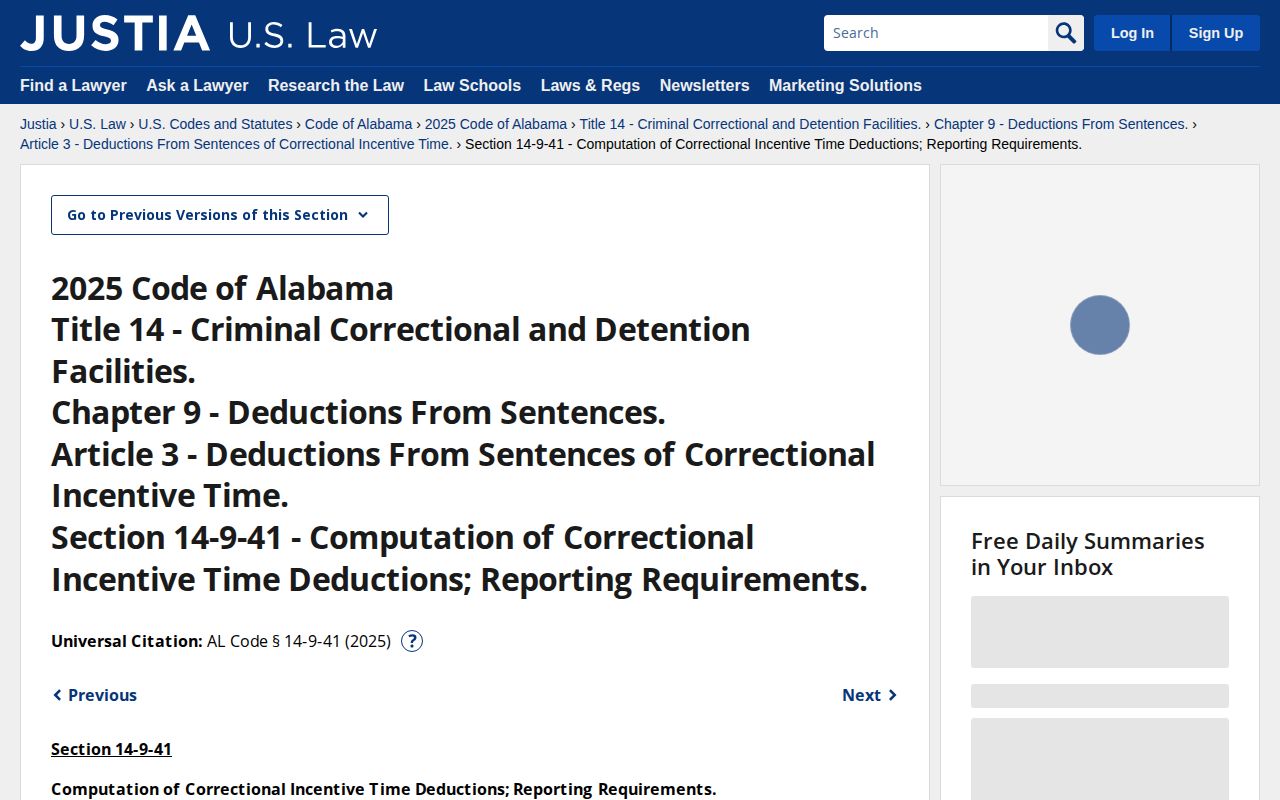
Alabama Correctional Incentive Time is governed by Ala. Code § 14-9-41. The release-date effect depends on legal eligibility, classification, offense, sentence length, discipline, jail credit, court orders, and amendments that apply to the sentence. The practical point for Calhoun County users is that ADOC calculates the state-prison date. The public should not estimate it by subtracting a fixed percentage from the sentence.
ADOC's own field definitions explain why the date moves. Good Time Received can affect the minimum release date, while Good Time Revoked can push it later. Jail Credit can also matter because time credited from county custody may affect the sentence calculation after a Calhoun County case becomes an ADOC sentence. A corrected sentence or new court action from the circuit clerk can change the computation.
Mandatory Release Layer
Mandatory release supervision is separate from ordinary good-time release. ABPP says mandatory release under Ala. Code § 15-22-26.2 applies to offenses committed on or after January 30, 2016, with exclusions for individuals convicted of a sex offense involving a child and those serving life sentences. ADOC determines the mandatory release date and coordinates with ABPP to prepare for release to supervision.
The ABPP material gives the statutory timing ranges: for sentences of five years or less, release is no less than three and no more than five months before end of sentence; for sentences more than five but less than 10 years, no less than six and no more than nine months before end of sentence; and for sentences of 10 years or more, no less than 12 and no more than 24 months before end of sentence. Those ranges are not county-jail bond release dates. They apply to eligible ADOC cases.
Parole Consideration Date
Parole eligibility is calculated by the Alabama Bureau of Pardons and Paroles under Ala. Code § 15-22-28(e). ABPP says sentence, crime, jail credit, ability to earn good time, time served, and sentencing-court orders can affect eligibility. Once calculated, the inmate receives a parole consideration eligibility date, sometimes called a set date.
The set date is a month and year for processing the file after eligibility arrives. It does not guarantee that a hearing will happen that month or that release will happen after the hearing. If parole is granted, ABPP verifies the home plan and coordinates with ADOC to schedule release. ABPP says it cannot give an exact release date during that coordination process.
Why Dates Change
Release timing can change in both the county-jail and ADOC systems. The reason should be verified from the agency that controls the person at that stage.
| Factor | How it can change release timing |
|---|---|
| Judge's order not received | Calhoun County's bond information says the jail must receive a judge's release order before release even when bond has been paid. |
| No-bond charge, hold, or detainer | A person may be transferred or held for another agency instead of released to the community. |
| New charge or amended sentence | A new case or circuit clerk sentence change can affect ADOC's calculation. |
| Good time received or revoked | ADOC's minimum release date can move earlier or later depending on earned credit and disciplinary loss. |
| Jail credit correction | Credited county custody time can affect a state-prison sentence calculation. |
| Parole denial or reset | ABPP review timing can change without changing the end-of-sentence date. |
| Home-plan verification | A parole grant may still require ABPP and ADOC coordination before the actual release is scheduled. |
| Data lag | Jail, court, ADOC, ABPP, and VNS systems may update at different times. |
Confirming the Release
For Calhoun County Jail, confirm the actual release through the jail release or booking record, the court order, the bond record, or the municipal court record if the arrest was municipal. The sheriff's jail administrative materials support the records path because they describe inmate files, court orders, legal documentation, and inmate-related information.
For ADOC, confirm while the person is still incarcerated through the ADOC inmate search and definitions. After release, use Alabama VNS notices, ABPP parole or supervision records, court disposition, or an ADOC records request. ADOC lists Central Records at 334-353-9738 and public.records@doc.alabama.gov, and the public-record form carries a $20 non-refundable processing fee. For local supervision after an ADOC release, the ABPP Anniston Field Office at 1201 Gurnee Avenue, Suite 2, Anniston, serves Calhoun and Cleburne counties.